

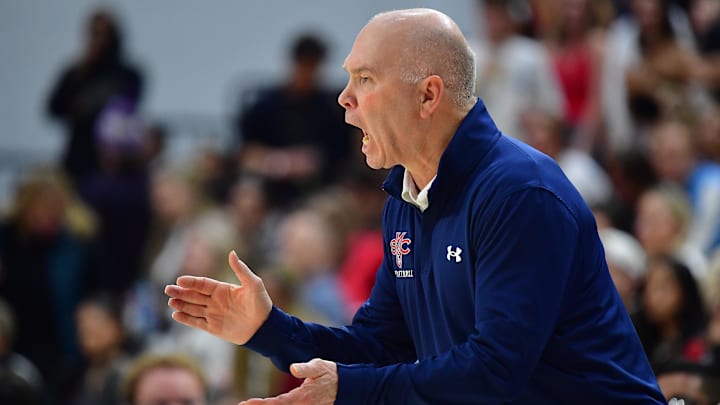
Randy Bennett will have to wait to officially introduce himself to his new school, but the newest head coach of the Sun Devils really needs no introduction. The longtime St. Mary's leader has a reputation that precedes him, but some fans aren't entirely convinced he'll be a slam dunk in Tempe.
In that spirit, here are three reasons Bennett can thrive at Arizona State, and one reason he may not.
Reasons he can thrive
Doing more with less
One thing you have to understand to coach at Arizona State is how to do more with less. The Sun Devils aren't completely devoid of resources, but they are seriously lacking in comparison to the rest of their Big 12 opponents.
In terms of NIL dollars, Arizona State is comfortably in the bottom half of the conference. There is potential to jump into the top half, especially if James Harden starts to open up his checkbook more, but donors have generally been reluctant to give to basketball before seeing proof of concept. Bobby Hurley never really got to that stage.
The facilities are about to get better, too. Desert Financial Arena is about to undergo a multi-year renovation plan that should greatly improve the game day experience. The $100 million renovation plan has been sorely needed for several years.
Still, Arizona State is not going to command top-level resources, at least initially.
That's where Bennett can really thrive. At St. Mary's, he never had top-of-the-line resources, even for a mid-major. Bennett became a master of scouting hidden gems, finding players who fit into his specific schemes and going after them early.
He also was one of the first coaches to start heavily recruiting Lithuania and Australia, finding multiple players from each nation that became key players and household names for the Gaels. When some questioned whether St. Mary's would finally fall off during the rise of NIL and the transfer portal, Bennett continued to field strong, consistent teams and reached the NCAA Tournament five straight years.
In Tempe, Bennett will have more resources than he previously had, but not enough to contend with Big 12 rivals on the recruiting trail. That's where his prior experience comes in big.
Style of play that works
Bennett's style of play is well-established at this point. On offense, he runs a variant of the Princeton offense that features constant motion and cutting with a focus on three point shooting. On defense, St. Mary's has dominated opponents with a suffocating pack line defense that seeks to eliminate opposing three point shooting.
It's a style that's been described as boring. In fact, St. Mary's is typically one of the slowest offenses in college basketball - their 67.7 possessions per game ranked 316th out of 365 teams - and their intense defense combines for low scoring affairs most of the time.
Some have questioned whether that can work in the Big 12, where players are bigger and faster. Bennett's team did have problems against Texas A&M, who play with a polar opposite and lightning fast pace, but the problems in that tournament game were about more than just scheme.
In fact, Kelvin Sampson has dominated the Big 12 with a nearly identical approach.
Sampson had the Cougars regularly reaching the NCAA Tournament while members of the American conference. He did it with very different schemes but an overall similar approach - slow, methodical offense and stifling defense - as Bennett. When Houston jumped to the Big 12, some wondered if he'd have to adjust.
Houston went to the Sweet Sixteen in their first year, then reached the title game last year. They've already gotten back to the Sweet Sixteen, with designs on more than that, despite having a slower offense - 327th in possessions per game - than the Gaels.
Bennett is in a slightly different situation, as he's taking over a whole new program as he enters the Big 12, but there is at least proof of concept that his brand of basketball works in the Big 12.
Local ties can reinvigorate NIL
The general perception from many regarding Bennett is that he won't engage boosters in the way that Kenny Dillingham has to increase NIL funds. While that may be true, it's likely more so because Dillingham is a rare breed, and not because Bennett won't be able to raise money.
It's true that Bennett did little to generate money at St. Mary's, but the Gaels also didn't have an NIL collective formed until two years ago. His existing recruiting pipelines made NIL a bit less crucial, too.
At Arizona State, Bennett will need NIL one way or another. But there's reason for optimism when it comes to his fundraising prowess.
Born and raised in Mesa, and the son of a legendary local coach, Bennett has very strong ties in the Valley that he's maintained very well. Many of those ties are people who haven't really been active in supporting Sun Devil athletics of any kind, let alone basketball. However, because Bennett is the coach now, that could easily change.
Not only does Bennett bring an entirely untapped pool of potential new donors, he brings a level of credibility that no Arizona State coach has had in quite some time. His pitch is easier to make on that basis alone, especially when sitting down with people like Harden.
Reason he can't
The Big 12 is just too stacked
The Big 12 is the premier basketball conference, without question. They've sent seven or more teams to the NCAA Tournament each of the last six years; this year, they sent eight, with three of them being a 1- or 2-seed.
The path to the tournament is fairly straightforward: finish in the top half of the conference and you should be in, or at least right on the bubble. However, that's easier said than done.
In two seasons in the Big 12, Bobby Hurley finished 15th and 12th, respectively. This season notably saw both Baylor and Kansas State - typical tournament teams - regress considerably. Odds seem low that either or both of those programs are as bad next year.
Oklahoma State and BYU will both be entering their third year with their current head coach, while West Virginia just wrapped up a promising first year with their coach; all three are considered programs on the rise. Cincinnati, meanwhile, just hired Jerrod Calhoun away from Utah State.
Then there's the powerhouses: Houston, Kansas, Texas Tech, Iowa State, TCU, and (unfortunately) Arizona. Those six teams are typically going to be good bets each year to go dancing, leaving a very slim margin for others that are on the rise.
In short, the Big 12 is a gauntlet.
The conference is unlike anything Bennett has ever faced. Across his 25 seasons with St. Mary's, there were only four years where the West Coast conference had more than two teams with 25+ wins. In most years, the top competition was Gonzaga and St. Mary's, and that was it. Occasionally BYU or Santa Clara would pop up as well.
In the Big 12, there are typically four or five teams that cross that 25-win threshold. Even the ones who fall just shy are stronger teams overall due to a tougher schedule by nature of playing in the Big 12. Every conference game brings the type of intensity you'd expect in March.
Bennett has plenty going for him, and odds are he'll succeed in Tempe. But if he doesn't, it will almost certainly be because the Big 12 was simply too much to overcome.
 Add us as a preferred source on Google
Loading recommendations... Please wait while we load personalized content recommendations